
Megha Manchanda | New Delhi
A mound of garbage along National Highway 1, leading towards Haryana and Punjab, is hardly the welcome anyone expects when entering or exiting the national capital. The Bhalswa landfill—one of Delhi’s three major waste dumps—has long been an eyesore. Yet, for most Delhiites, its visual blight is far less worrying than the toxic fumes it releases into the air.
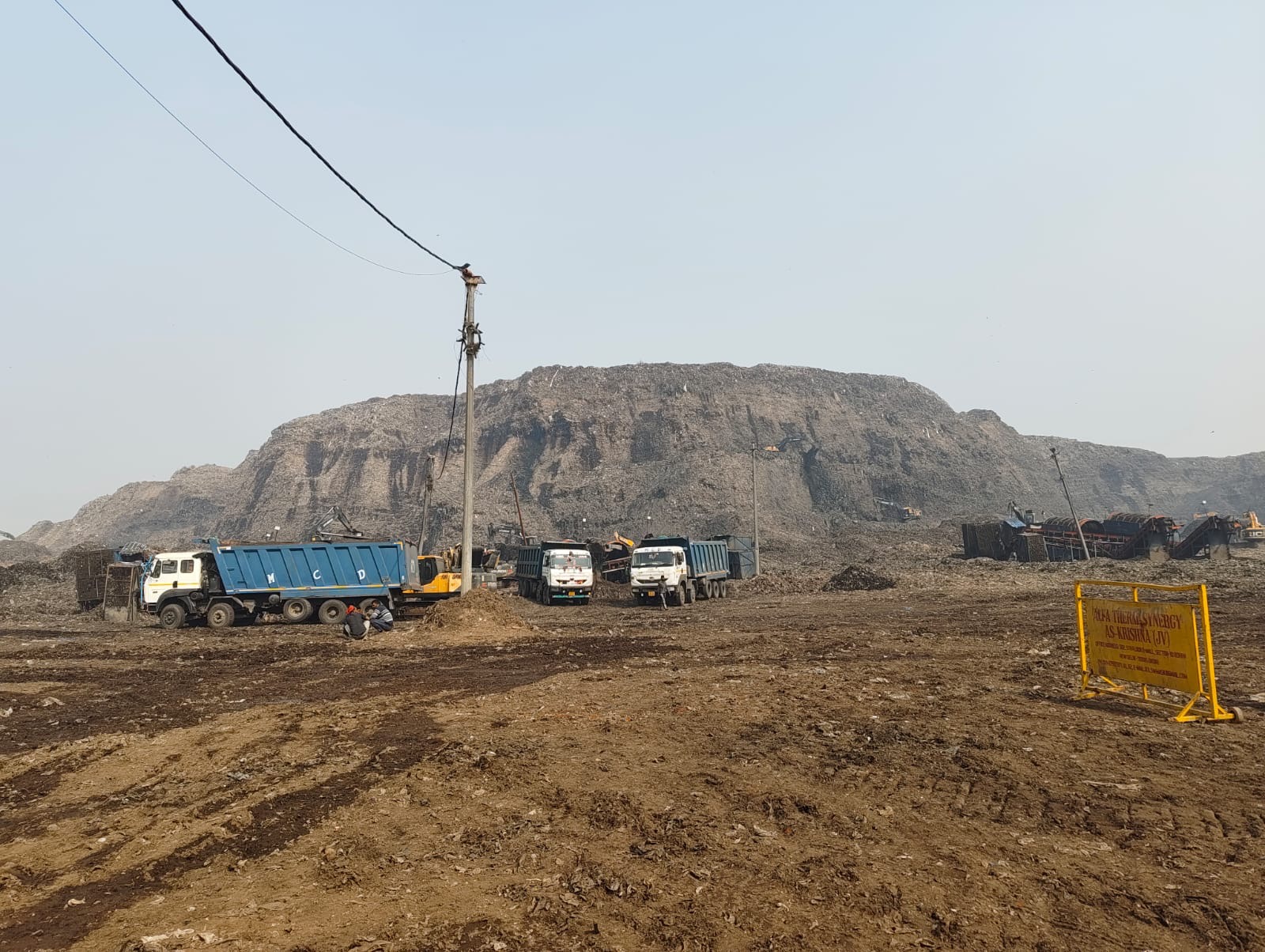
Every day, the Bhalswa landfill handles nearly 12,000 tonnes of garbage, contributing to a growing environmental crisis. The Municipal Corporation of Delhi (MCD), responsible for managing the city’s waste, has announced plans to convert this landfill into a biogas plant by December 2026. Until then, the site continues to add significantly to Delhi’s pollution burden.
Methane Leaks and an AQI in the Red Zone
With the city’s Air Quality Index hovering around 600 — dangerously hazardous levels — methane emissions from Delhi’s landfills have emerged as a major contributor. According to AQI data, the three sites — Ghazipur, Bhalswa and Okhla — are leaking substantial amounts of methane, a potent greenhouse gas that accelerates climate change.
“Every day, Delhi dumps over 10,000 tonnes of waste, with 50–55% being food scraps and other biodegradable waste that rots and releases methane. Since 2020, satellites have detected 124 major methane leaks, including one from Ghazipur in 2021 that released 156 tonnes per hour—equivalent to emissions from 24 million cars running simultaneously,” AQI noted.
Inside Bhalswa
A worker at the Bhalswa site, who preferred to remain unnamed, explained that the landfill recovers three components from the waste: Inerts (INNET), Combustible Non-Dimensionals (CND) and Refuse-Derived Fuel (RDF)
These materials are used by the Delhi Development Authority (DDA) at construction sites, and in the case of Bhalswa, for landfilling at the newly launched UER-II expressway project, inaugurated by Prime Minister Narendra Modi in August this year.
Missed Deadlines and an Overdue Transition
While the MCD plans to transform the Bhalswa site into a full-scale waste processing facility, the timeline continues to shift. An official, speaking off the record, said the corporation had originally aimed to remove the garbage mound and operationalize the facility by June 2026, but the deadline has now moved to December 2026.
Bhalswa, commissioned in 1994, along with Ghazipur (1984) and Okhla (1996), predates the Municipal Solid Waste (MSW) Rules, 2000. None of the three landfills meets the technical standards mandated under Schedule 3 of these rules, which outline safety and environmental safeguards.
The Delhi Pollution Control Committee (DPCC) has not granted authorisation to any of the sites. Yet municipal bodies argue they have no alternative, as Delhi simply does not have the land to develop new waste disposal sites. They have requested fresh land allotments from the DDA. In a stark admission, both North and South Delhi Municipal Corporations stated that these sites continue to operate “at the risk of human life.”
In an attempt to reduce landfill burden, Delhi has installed multiple construction and demolition waste processing plants. A 2,000 tonnes-per-day facility at Jahangirpuri, operated by IL&FS, converts C&D waste into tiles, pavement blocks, aggregates, and ready-mix concrete. Another 500 MTD plant at Shastri Park is already operational, with three more in the pipeline.
Pollution Crisis Deepens
Despite years of debate, Delhi and the NCR region continue to grapple with severe air pollution, particularly in winter. Low temperatures, fog, and stagnant air worsen the impact of pollutants, pushing public health to the brink. In recent weeks, temperatures across North India have dipped to 8–12°C, while pollution levels have remained stubbornly high.
According to the Indian Institute of Tropical Meteorology’s Decision Support System, vehicular emissions remain the largest source of Delhi’s pollution at 19.5%, followed by industrial activities, biomass burning, and landfill emissions.
Image Source: Enersider Markets Media