In Thermax’s Fireside Podcast, Nishaanth Balashanmugam, CEO and Director GH2 India sits down with Arun Unni, Head of New Energy & Strategy at Thermax, to explore how six decades of industrial legacy are being leveraged to build India’s green hydrogen future and drive deep decarbonisation.
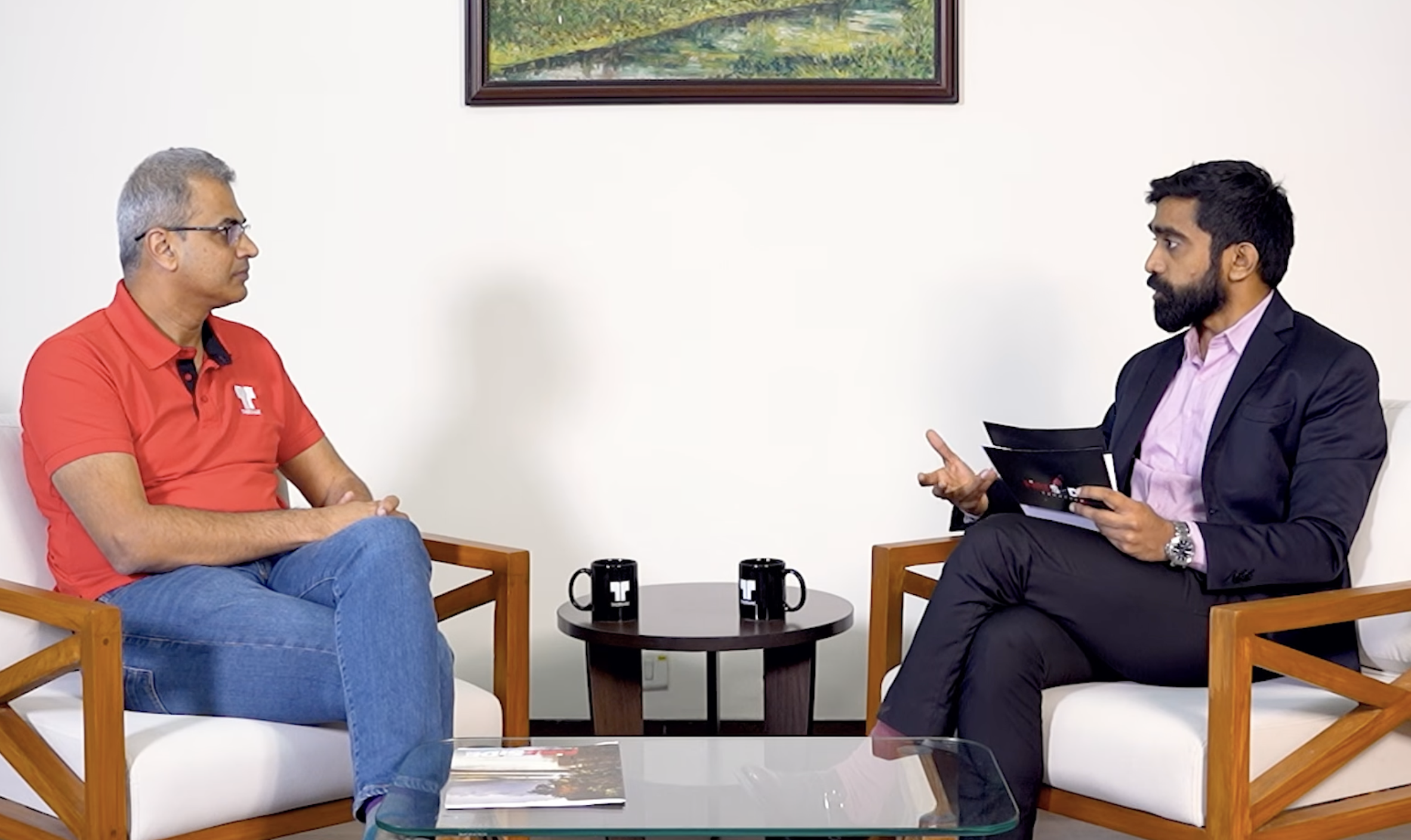
Image Credits: Fireside TechTalk
Following are the edited excerpts from the interaction:
In your lens, what is green hydrogen, why green hydrogen, and where does green hydrogen fit?
Let me contextualise green hydrogen in terms of where it fits in the overall scheme of decarbonisation – in an industrial context, the easiest way to decarbonise is to just use less energy as efficiency is the fastest way. Once you’ve exhausted efficiency levers, the next cheapest option is typically electrification or using green electrons. Then you come to a point where you need molecules, there are two molecules that dominate where decarbonisation can happen – methane and hydrogen. Without methane and hydrogen, decarbonisation is simply not possible. Green hydrogen is not an option. It’s not a question of if green hydrogen needs to happen, it’s a question of when.
As the head of strategy, how are you enabling this entire energy transition?
At Thermax, we are deeply integrated with our industrial customers, we are predominantly a B2B company, and we are deeply integrated in our customers’ needs for clean energy, clean air and clean water. Every element of what green hydrogen is as a technology – whether it is the need for water, the need for energy efficiency, how to optimise an overall system, integrate EPC (engineering, procurement and construction) – these are all aspects that we’ve been familiar with for 60 years. It just now converges to a technology where all of it actually makes sense.
In 60 years, what has Thermax been doing in all of these various elements that you said are coming together – efficiency, reduction of heat, EPC work?
Everybody who’s been part of the industrial sector in India over the last 50 to 60 years would recognise Thermax’s name from a boiler perspective. We are known for our boilers, heat management, and heating solutions. Natural adjacencies included water, pollution control, chemicals, and then new energy businesses including power. All our customers need water in various forms – whether at the beginning of the process or at the end as effluent treatment. The entire process of renewable energy as an input is something we understand very well. We already have a Commercial & Industrial (C&I) business of 300 megawatts going quickly to 450 megawatt, which will be a gigawatt by the end of next year.
Who are you partnering with, and what are you looking out for?
On alkaline, we are working with Hydrogen Pro; on SOEC, which is another electrolyser technology, we are working with Ceres Power. In each of these cases, these partnerships are joined at the hip because we believe that the Indian context of hydrogen generation is going to be different from how it works in the rest of the world. We are also partnering fundamentally at the R&D side. Our recent MOU with HPCL had electrolysers as one of those elements. Partnerships are the way to go.
You’re not merely looking at going and installing a product; you’re looking to serve this over a lifetime. Can you expand on that?
The way we fully expect is that we will get better and better at optimising electrolyser systems as we operate them more and more. The first year will deliver the guaranteed outputs that we are committing to the customer. But there is a significant opportunity after that as analytics comes in. We are very clearly looking at these as 20-year relationships with our customers rather than a one-time sale. We are committed to building a local ecosystem, a local network of service, spares, and all other kinds of facilities needed to service this from a lifetime perspective.
Does this also translate into global ambitions, or are you just looking at Indian conditions and the Indian market currently?
I would say both, but it has to be India first, not global first. India is becoming the hotbed for where green hydrogen is evolving in many ways. You have to have a relevant presence in India, and that will tell the world that you are competitive enough and strong enough to play in this space. For us, it is India first and then the world – definitely the world as a second chapter. We are reasonably global in our approach. Many SBUs within Thermax sell the majority of their products globally – our cooling business, our chemicals business.
How are you handling the potential rigidity of a 60-year-old legacy company? How are you committing yourself to the energy transition and repositioning Thermax as a partner for energy transition?
The credibility of a brand that has survived and succeeded for a few decades allows you to initiate conversations which are not easy to do for many other brands. It allows us an opportunity to have the energy transition conversation. But after having initiated the conversation, you need to stand on your own in terms of your abilities in the technologies that you’re looking to deliver. We are having to build our ground and prove our mettle. We see new energy as a natural hedge. If energy transition moves slow, we have an existing portfolio. If it moves fast, we want to be ready. Either way, Thermax has a role to play.
How are you managing inherent market risks if hydrogen takes a little bit longer? How do you view that, and how are you readjusting your strategies?
We are very lucky in the sense that we are a patient, promoter-driven organisation. Our promoters have very clearly set it up to be a longer-term picture. Results in one or two years can go one way or the other, but over the long term we are committed to making this work. That’s what you need to succeed in this space – a lot of resilience.
How are you going to keep up with competition from China, and how are you going to convince customers to buy Thermax’s electrolysers?
From our perspective, the competitive costs that are there in the market need to be met. Our whole effort at indigenisation – even the way components are being sourced from various locations – we are very clear that we are sourcing in a very cost-optimised way. This is not more expensive than competition products. This is a product that when you put together and operate on a lifetime basis should give you a more competitive LCOS (Levelised Cost of Storage). You have to be cost competitive. We are fully geared up to work towards that.
Can you expand a little bit more on geopolitics, green hydrogen, and India’s positioning?
Purely from an economics perspective, many things converge in India which allow it to be a good global hub for both green hydrogen and ammonia as well. Not only do we have some of the cheapest renewable costs in the world, we have electricity networks which allow you to transport it from the cheapest electricity source to the right place where hydrogen needs to be done. The other thing is the pool of talent – the soft product of intellectual capability, expertise, and technical know-how of setting these up and operating them is something that India will be able to export.
What would you say to people who are still on the fence about green hydrogen and are not true believers?
I start with the thesis that green hydrogen is not an ‘if’, it is a ‘when’. There’s a percentage of the decarbonisation of the world that cannot happen without green hydrogen. If at all you believe in energy transition, then you will land up at a point where you have to believe in green hydrogen. It is the right to question whether it is 2027, 2030, or 2035. All the numbers show that it is coming sooner rather than later.