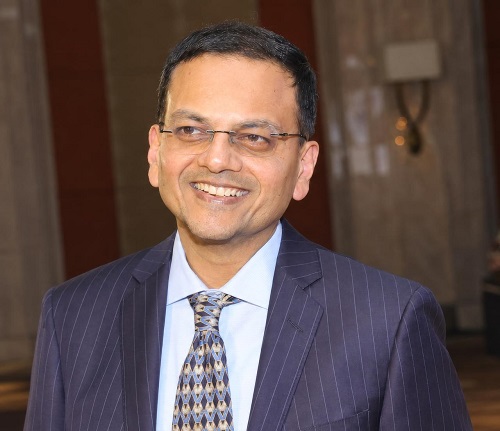

 With over 25 years in the global energy sector, Ashish Khanna, Director General of the International Solar Alliance (ISA), blends technical expertise with a clear sense of purpose. A former World Bank energy specialist, he has spent much of his career working to bring clean, affordable power to people across Africa and India. Driven by the belief that energy access can transform lives, Khanna has helped shape policies, attract investments, and inspire innovation across the solar value chain.
Blessed with abundant solar potential, African nations have taken a decisive step forward by collaborating with the International Solar Alliance (ISA) to expand their renewable energy initiatives.
At the recently concluded ISA Assembly, several small island nations from Africa entered into partnerships with the global body to promote affordable off-grid solar power solutions, deploy solar pumps to enhance water security, and improve access to electricity.
Ashish Khanna, Director General of ISA, ensured the seamless conduct of the assembly in the National Capital, steering discussions towards tangible outcomes. With over 25 years of experience across the energy sector, Khanna has served in both public and private domains. His deep understanding of Africa’s energy landscape stems from extensive work across North Africa and Sub-Saharan regions, among others.
Khanna’s expertise spans the entire solar energy value chain—from project conceptualisation and resource mobilisation to financing and implementation. A veteran in the global energy space, he has played a pivotal role in shaping the World Bank’s West and Central Africa programme, paving the way for energy access to 300 million people across the continent by 2030.
In North Africa, he led a major programme that enabled private sector investments worth USD 20 billion in Egypt’s energy sector. In India, as Lead Energy Specialist at the World Bank, Khanna worked closely with the Ministry of New and Renewable Energy (MNRE) to frame policy and regulatory reforms fostering private sector participation in the solar domain.
Looking ahead, India aims to emerge as a global hub for solar energy by 2050—aggregating worldwide demand while driving innovation, manufacturing, and knowledge exchange. Achieving this vision calls for synergy between climate action and rural prosperity as the foundation for sustainable development.
India currently ranks fourth globally in overall installed renewable energy capacity and wind power generation, and third in solar power generation. The nation’s renewable energy capacity has tripled to 257 GW from 81 GW in 2014, while solar capacity alone has grown from 2.8 GW in 2014 to 128 GW today.
In August this year, Moldova became the 107th member of the ISA. Founded in 2015 by India and France at COP21 in Paris, the ISA aims to unlock solar investments by 2030 while reducing technology and financing costs. The Alliance promotes solar applications across agriculture, health, transport, and power generation.
With 125 member countries today, the ISA continues to drive change by facilitating policies, sharing best practices, developing common standards, and mobilising global investments. It is actively creating platforms to unite nations, aligning with its broader mission of building frameworks for aggregated demand.
Khanna emphasises that ISA’s success hinges on a strengthened organisation—one equipped with the right skills, accountability systems, and institutional integrity to earn the trust of member countries and their agencies in designing and implementing sustainable solar pathways for energy access, efficiency, and transition.
Khanna holds dual postgraduate degrees in Management and Public Administration.