
By Enersider Desk | New Delhi
The Global Carbon Council (GCC) and The Energy and Resources Institute (TERI) have signed a Memorandum of Understanding (MoU) to establish a digital carbon marketplace for household and livelihood-based clean energy projects in India under TERI’s LaBL 2.0 -Lighting a Billion Livelihoods programme, according to a joint statement.
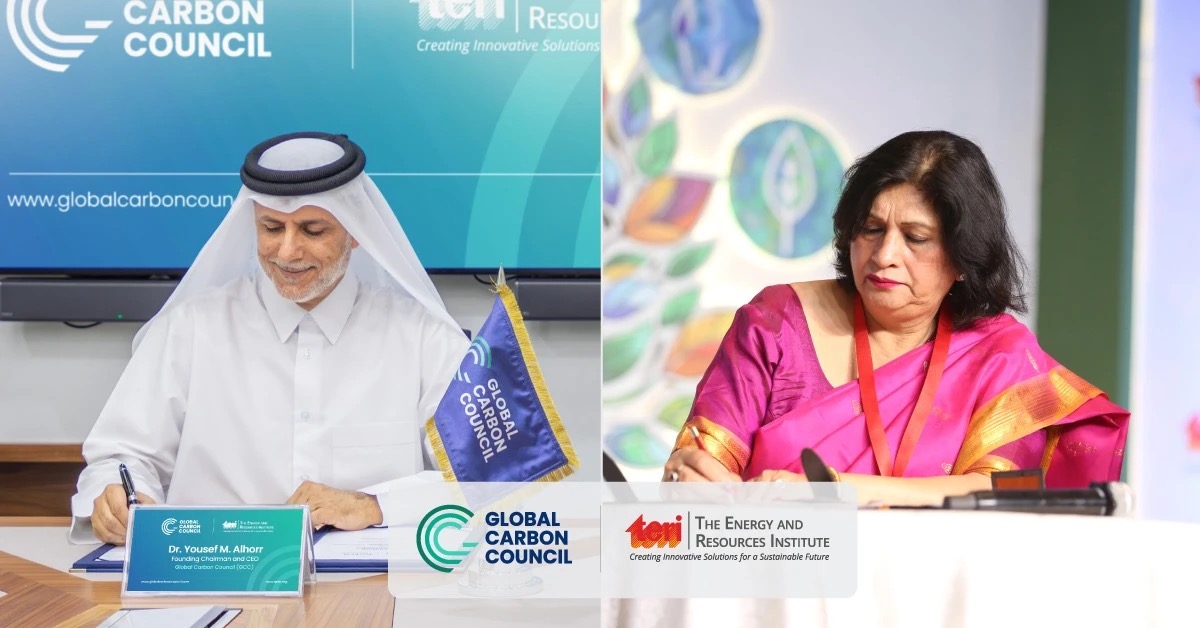
The MoU was formalised by Founding Chairman of GCC, Dr Yousef Alhorr, and Director General of TERI, Dr Vibha Dhawan. The partnership aims to facilitate carbon finance for Distributed Renewable Energy solutions, including solar lighting systems, clean cooking technologies and productive-use appliances deployed in rural and underserved communities.
According to the statement, the collaboration will enable aggregation of small-scale, household-level clean energy interventions and convert them into measurable and verified carbon credits that can be traded in international carbon markets. The initiative seeks to improve access to carbon finance for community-scale projects.
India sourced over 50 per cent of its installed electricity capacity from non-fossil fuel sources in 2025, achieving its Paris Agreement clean energy target ahead of schedule. However, an estimated 250 million people continue to lack access to clean and reliable energy solutions. Decentralised renewable energy is seen as a key component in addressing both energy access and climate mitigation goals.
Under the agreement, LaBL 2.0 projects will be linked with GCC’s carbon market infrastructure. The two organisations will explore development of a fully digital Energy Access and Carbon Marketplace or integration of projects into GCC’s World Bank-supported ASCENT Energy Access Portal.
The proposed platform is expected to use Digital Monitoring, Reporting and Verification systems to aggregate projects, reduce transaction costs and ensure transparency and traceability in the issuance and retirement of carbon credits.
The initiative will also involve engagement with relevant Indian government institutions to explore potential recognition of LaBL 2.0 carbon credits under compliance carbon markets, including mechanisms such as Article 6.2.
The initiative will be supported by GCC’s digital Carbon Market Infrastructure to ensure accounting from project registration to issuance and retirement of carbon credits, with safeguards to prevent double counting.
The two organisations said the model could serve as a template for other developing countries seeking to link household-level climate action with international carbon markets.
Image Source: Global Carbon Council
Also read: AGEL arm commissions 185 MW wind energy project in Gujarat