
By Enersider Desk | New Delhi | 12 June 2026
The CSIR-Central Road Research Institute (CSIR-CRRI) and the Municipal Corporation of Delhi (MCD) have signed a Memorandum of Agreement (MoA) to strengthen road assessment, construction quality supervision and capacity building for MCD engineers and staff.
The collaboration aims to improve the quality, durability and sustainability of Delhi’s road infrastructure through scientific road evaluation, quality assurance and the use of innovative
The agreement was signed on 10 June 2026. Both organisations also signed a Bi-partite Technology Management Agreement for the implementation of ECOFIX, an instant pothole repair technology developed by CSIR-CRRI using iron and steel slag aggregates.
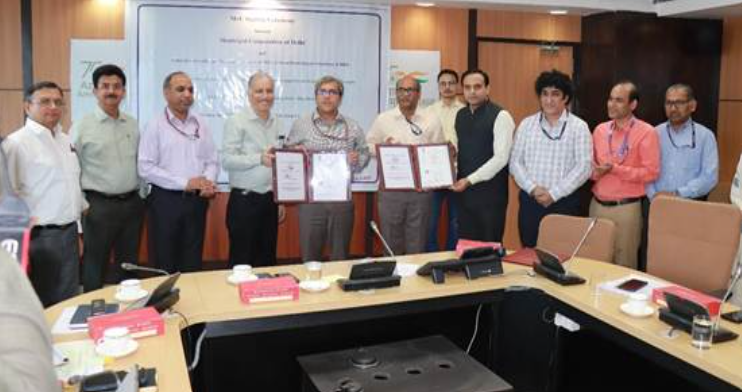
Image Credit: PIB
The partnership would help strengthen the civic body’s technical capabilities while enabling faster and more durable road repairs, according to Sanjeev Khirwar, MCD Commissioner.
He said, “The collaboration would strengthen MCD’s technical capabilities while enabling faster and more durable repairs through technologies such as ECOFIX.”
CSIR-CRRI Director Dr Ch. Ravi Sekhar highlighted the institute’s long-standing contribution to the road sector and said “the partnership would provide technical support to MCD in road evaluation, quality supervision and the deployment of sustainable technologies”.
He added, “Technologies such as Steel Slag Road Technology, ECOFIX, Rejupave and MSS+ promote resource conservation, circular economy principles and reduced carbon emissions.”
The initiative is being led by Satish Pandey, Head of the Flexible Pavement Division at CSIR-CRRI and inventor of Steel Slag Road and ECOFIX Technology. He said, “scientific road evaluation, quality supervision and the adoption of advanced maintenance technologies would improve road serviceability, durability and lifecycle performance while reducing maintenance-related disruptions”.
According to the organisations, improved road conditions and timely repairs are expected to reduce road dust generation, while the use of steel slag and recycling-based technologies will help conserve natural resources and support circular economy practices.
The initiative is aimed at developing resilient, sustainable and citizen-centric road infrastructure across the national capital.