
By Enersider Desk | New Delhi | 2 July 2026
Union Minister for Environment, Forest and Climate Change, Bhupender Yadav, today emphasized that India’s shift to electric mobility must be driven by principles of green growth, resilient infrastructure, transparent governance, and a circular economy to ensure long-term environmental sustainability.
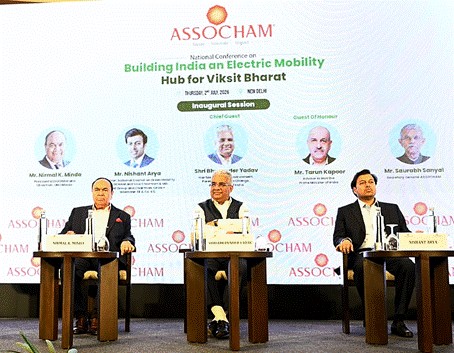
Yadav was speaking as the chief guest at the National Conference on ‘Electric Mobility: Building India an Electric Mobility Hub for Viksit Bharat’, organized by the Associated Chambers of Commerce and Industry of India (ASSOCHAM) in New Delhi. The conference brought together policymakers, industry leaders, automotive manufacturers, and technology providers to deliberate on accelerating India’s electric mobility transition and strengthening its position as a global EV manufacturing hub.
Addressing the inaugural session, Yadav stated that the transition is not merely about replacing one technology with another, but about building a sustainable industrial ecosystem that strengthens manufacturing, creates green jobs, and supports the vision of Viksit Bharat by 2047. He noted that the government has undertaken a series of reforms to simplify environmental clearances, digitize approval systems through the PARIVESH portal, rationalize compliance requirements, and promote ease of doing business without compromising environmental safeguards.
Yadav stressed that India’s future lies in moving from a linear ‘take-make-dispose’ model towards a circular economy based on reuse, recycling, and sustainable resource management. He said electric mobility must be supported by robust charging infrastructure, localization of advanced manufacturing, secure critical mineral supply chains, battery recycling, and resource efficiency.
He called on industry, policymakers, and institutions to work together to build an innovation-led ecosystem that positions India as a global hub for clean mobility. “Ecology and economy must progress together, and through collaborative action, India can emerge as a global leader in sustainable manufacturing, green mobility and climate-conscious development,” Yadav added.
The conference deliberations highlighted the need for policy continuity, stronger charging infrastructure, localization of manufacturing, resilient battery supply chains, financing support, and technological innovation to accelerate EV adoption.
The inaugural session also featured ASSOCHAM President and Chairman of UNO Minda, Nirmal K. Minda; Chairman of ASSOCHAM National Council on Green Mobility and Vice CMD of JBM Group, Nishant Arya; and ASSOCHAM Secretary General, Saurabh Sanyal.
Also Read: BPCL signs definitive agreements to fully acquire Brazil-based oil and gas firm